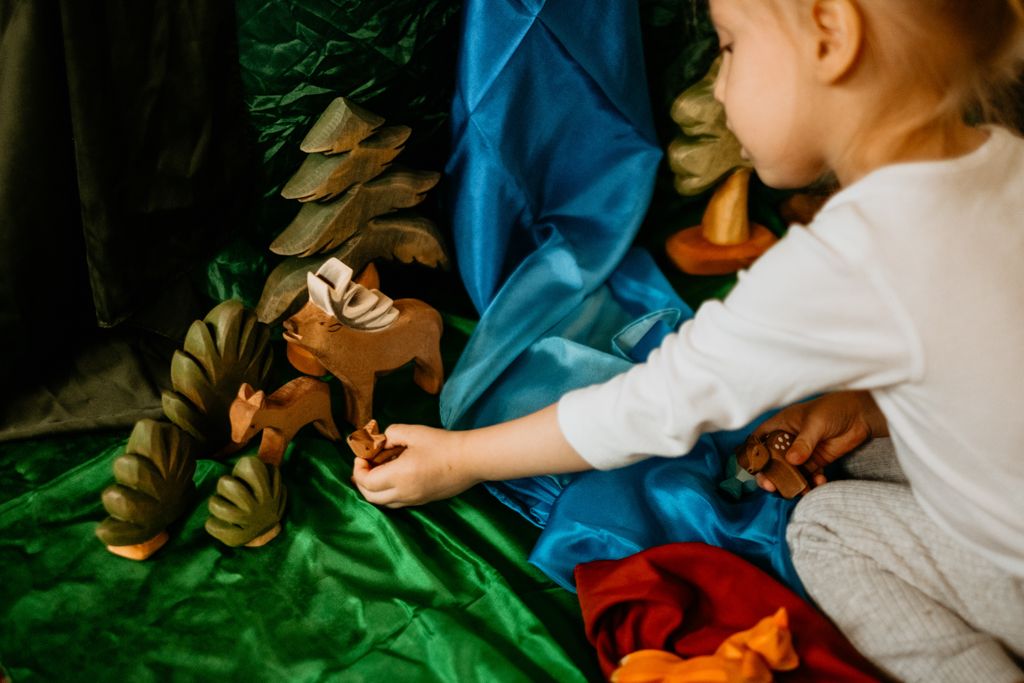
By the end of this guide you'll have seven festive play worlds ready to go, all built from one square of silk and whatever is already in your living room. A frozen kingdom, a stable, a starry night, a king's long journey, an angel, a present and a parachute drop from the sky. No kit, no batteries, nothing to assemble.
There's one method, in five steps. Each step lifts the silk into a new position: on the floor, over your head, on your shoulders, around a toy, up in the air. Each new position opens a new world. You set the scene, and your child takes it from there.
The steps: five ways one play silk becomes seven Christmas worlds
Step 1: lay the silk flat and it becomes a frozen kingdom
Spread a white or icy blue silk across the floor. Push a cushion under one edge and the flat ground rises into a snowy mountain. Scrunch the other side and you've got drifts.
Now bring the characters. Farm animals, wooden people, the little reindeer off the tree. Who skates on the lake? Who lives up the mountain? And who rules this frozen land?
Adventure one: the snowy kingdom.
Why does it work? A flat silk gives a story somewhere to happen. Children can't tell a tale in mid-air, but give them a ground to stand on and the plot arrives. Silk is fine enough to let the colour of the floor glow faintly through it, so a pale one looks more like ice than any painted mat. That's what the Frozen Lake colourway was dyed for.
How big is a frozen kingdom? As big as the room allows. Lay it on the coffee table and it's a pond. Spread it down the hall and it's a long march across the ice.
Step 2: lift the silk up and it becomes a roof
Set two chairs a little apart. Lay a broom handle across their backs, throw the silk over the top and there's a space underneath. Put a cardboard box inside with a doll in it, add a few farm animals, and you've built a stable.
Adventure two: the stable.
Children who have seen a nativity, at nursery or at church or in a picture book, will often act it out without being asked. Who's knocking at the door? Is there room?
Now swap to a deep blue silk with a few foil stars fixed to it. Same chairs, same broom handle, but the roof has become the sky. Lie underneath with the shepherds and look up. Which star is the brightest? Where is it leading?
Adventure three: the starry night.
Why does it work? Children love to be inside things. Dens, boxes, tunnels, the space under the table. The educator Chris Athey called this the enveloping schema, one of the repeated patterns children follow as they work out how the world fits together. A silk roof gives them a space of their own, and because silk lets light through, a lamp on the far side turns the den a deep, glowing blue.
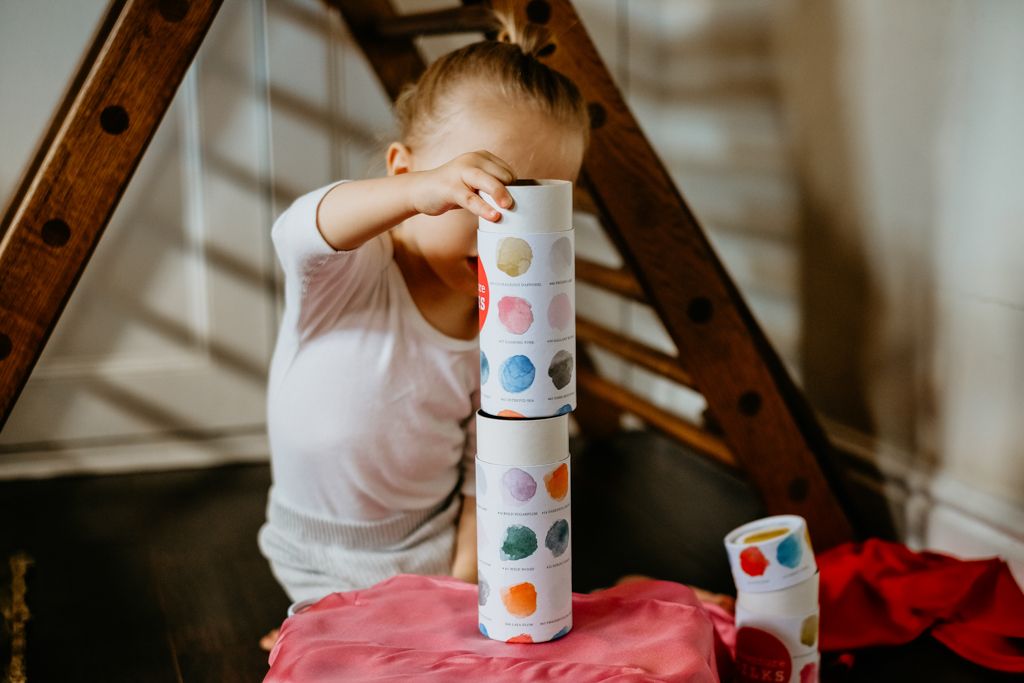
Step 3: put the silk on and become someone
Gather two corners of the silk, knot them loosely or clip them at the neck, and it hangs down the back as a cape. In a rich colour, it's royal robes.
The kings are coming, and they've a long way to travel. Their journey can start in the kitchen and cross the whole house: over the hall carpet, around the sofa, up to the top of the stairs. The star from step 2 is waiting at the end. Who's carrying the gold?
Adventure four: the king's journey.
If your child would rather be a hero than a king, the knot works the same. The Heroic Forest silk becomes a cape in seconds, ready for whoever is going to save Christmas.
Now take a white or gold silk. Tuck one corner into each sleeve cuff and clip the middle at the back. Arms out, and there are wings.
Adventure five: the angel.
Why does it work? Silk is light. When a child runs, a heavy blanket drags behind, but silk lifts and billows. Wings that flap when you flap your arms feel real in a way a costume from a packet rarely does. And because the silk is the costume rather than a set of rules, the angel can turn into a snow bird or a dragon by teatime.
Step 4: wrap the silk around a toy and it becomes a present
Lay the silk flat, put a toy in the middle, fold the sides in and tie two corners on top. It's a parcel. Pass it over, let it be unwrapped, then wrap it again for someone else. Who's it for? What's inside?
Adventure six: the present.
A present you can give twenty times before lunch is a fine game in December, and it rehearses the giving as much as the getting. Older children will wrap a teddy for a doll, then the doll's present for the dinosaur, until the whole toy box has had a turn.
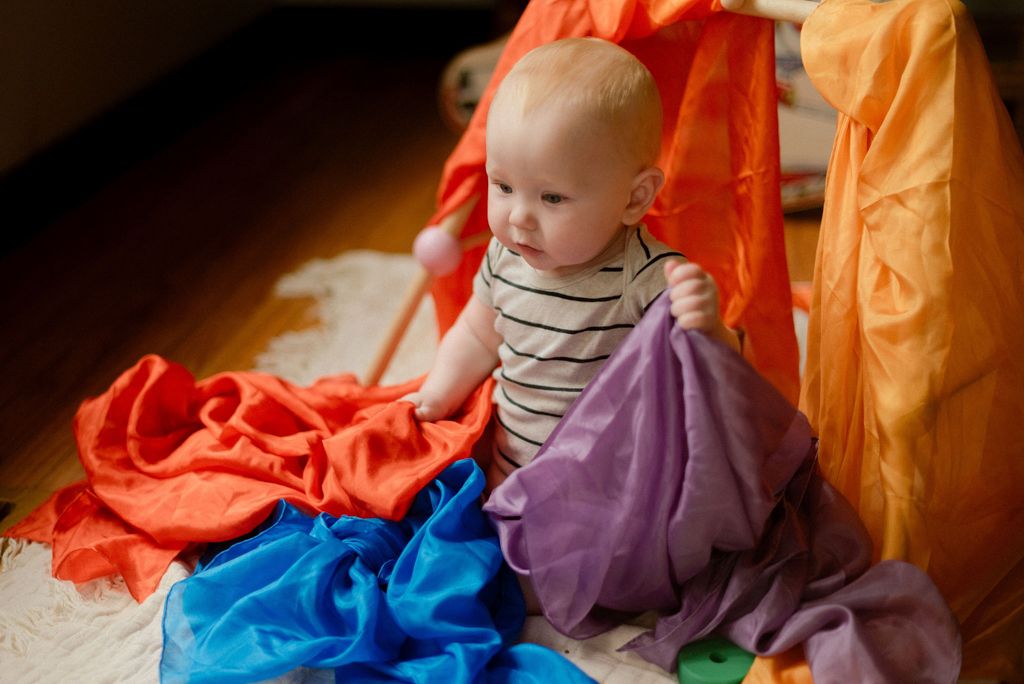
The same idea works with babies, long before they understand Christmas. From around four months, cover a toy near your baby and let her pull the silk away to find it, or hide your own face for a game of peekaboo. Stay with your baby throughout. She may well pull the silk to her mouth to find out how it tastes. That's what babies do, and the silks are EN71 tested with that in mind.
Why does a baby find this so gripping? Jean Piaget described object permanence: the slow discovery that things still exist when you can't see them. A baby working on that idea will lift the cloth again and again. Every time the toy is still there, the idea grows a little firmer.
Step 5: send the silk into the air and it becomes a parachute
Tie a length of string to each corner of the silk. Gather the four loose ends, knot them together and tie on a small toy. A little Father Christmas or an elf works well. Stand on a chair, hold the silk up and let go. Presents are being delivered from the sky.
Adventure seven: the parachute drop.
Why does it work? The silk catches the air and slows the fall. Drop the same toy without it and it lands with a thud. What happens with a heavier toy? A lighter one? From higher up? Without anyone calling it science, your child is testing air resistance, and every landing is another result.
Three common mistakes in Christmas silk play and how to put them right
Running the whole story ourselves
We build a beautiful stable, set every figure in place and then narrate the entire nativity. It's easily done, especially when the scene looks lovely. But a silk only works when the child does the work. Set the scene, add one question, then step back. Let the kings take a wrong turn. Let a dinosaur turn up at the stable. Your child's version may look nothing like yours, and that's the version that matters.
Building a world with no trouble in it
A snowy kingdom full of happy skaters is pretty, but it's a story that ends before it has begun. All lambs and no wolf. Every adventure needs a problem. Is there anyone more chilling than a snow queen? Perhaps the present gets lost on the ice, or the parachute lands in the wrong house. At five there's no nuance: villains exist to be beaten and justice comes fast. Add one obstacle and watch the story take off.
Keeping the silk for best
Silk looks precious, so it tends to end up folded away in a drawer. But it's strong. It will survive being dragged through a full-throttle afternoon. Children make up these games on their own once they know where the silks are and what they can do. A basket on the floor, within reach, turns a special-occasion toy into an everyday one. Add a second colour from the Adventure Silks or Wilderness Silks collections and the worlds multiply. For more ideas once the decorations come down, there are 100 ways to play with playsilks.
Why a silk with no job keeps working long after Christmas
The psychologist Lev Vygotsky noticed that in pretend play, a child can make a stick be a horse. To do that, she has to hold the idea of a horse in her head while the stick stays a stick. Pulling the meaning away from the object is one of the first big leaps of imagination.
A silk asks for that leap every time. It's one metre of silk with hand-rolled edges, and it has no function of its own. That's exactly why it can take whatever function the story needs. It's the one toy that a four-year-old and a nine-year-old will both still reach for.
By Boxing Day the frozen lake will be a river, the cape will be a sail and the stable roof will be a dragon's cave.
The silk doesn't know it's Christmas. Your child does.